CryoRad advances in the race to become ESA’s next Earth Explorer
|
October 14, 2026
NewsThe European Space Agency (ESA) has selected CryoRad as one of the three finalists to become the twelfth mission of its Earth Explorer programme. These research satellites test new ways of observing our planet to make scientific discoveries about the Earth. At Zenithal Blue, we are proud to be part of the international consortium developing the mission.
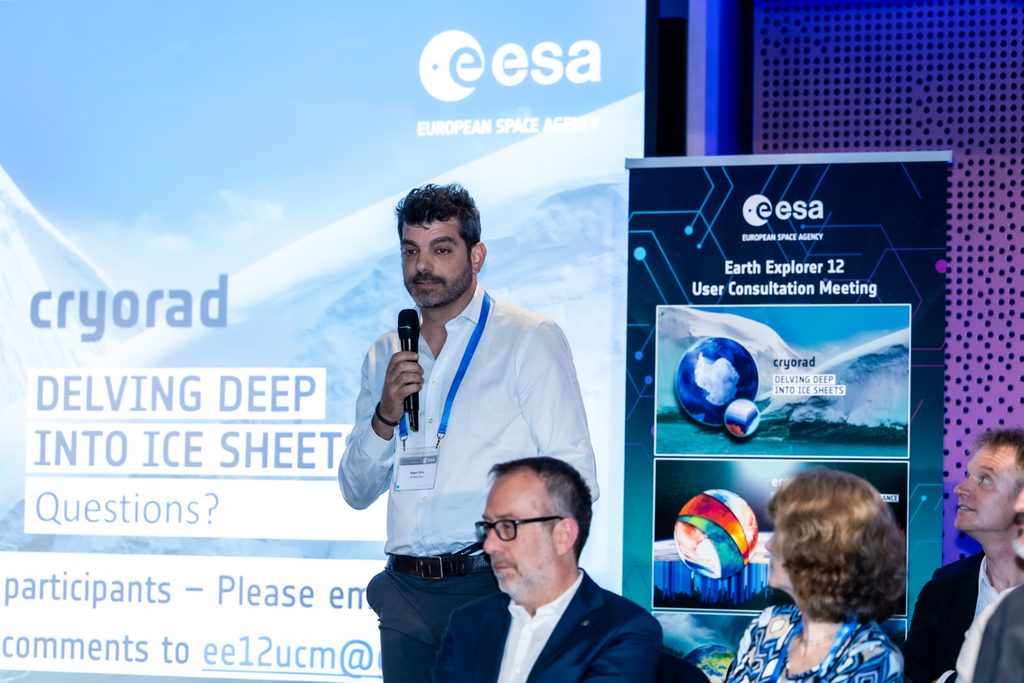
The decision follows the User Consultation Meeting held in Tallinn, Estonia, where four candidate missions were presented to the scientific community. CryoRad now moves forward alongside ECO and Keystone. One of the three will be selected in ESA’s next User Consultation Meeting, expected in 2028, for construction and launch around 2036.
A satellite to better understand the poles
CryoRad proposes a satellite carrying a broadband, low-frequency microwave radiometer operating between 0.4 and 2 GHz. This frequency range can penetrate the ice and reveal what is happening inside it, something current satellites cannot do.
It would focus on three aspects of the cryosphere:
- The temperature of the Antarctic and Greenland ice sheets, from the surface down to the base.
- The thickness of Arctic sea ice.
- Ocean salinity in cold waters.
CryoRad would significantly improve the accuracy of existing measurements and add new parameters that cannot be observed from space today.
Our contribution
CryoRad is being developed by an international scientific consortium, led by the Italian Institute of Applied Physics (CNR-IFAC).
Within this consortium, our team develops the mission’s end-to-end simulator: a digital replica that reproduces how the satellite would work, from the way it captures the signal to the data it would send back to Earth. The simulator also includes the challenges the satellite would face in real conditions, such as noise from the instrument itself or radio-frequency interference from other sources, including radars and telecommunications.
This tool allows the CryoRad team to assess the mission’s scientific feasibility and validate design choices before moving on to more advanced and costly development phases.
“CryoRad would give us measurements of the poles that we either don’t have today or can only obtain with limited precision”, says Roger Oliva, Director of Zenithal Blue. “With the ice melting faster because of climate change, monitoring the polar regions means better predicting sea-level rise.”
What comes next
Over the coming phase, the three candidate missions will be studied in greater depth before ESA makes its final decision. We look forward to continuing our work with the CryoRad team and will keep sharing updates along the way.
Read ESA’s announcement: Three Earth Explorer candidates go forward
Learn more about our work on CryoRad: CryoRad project page